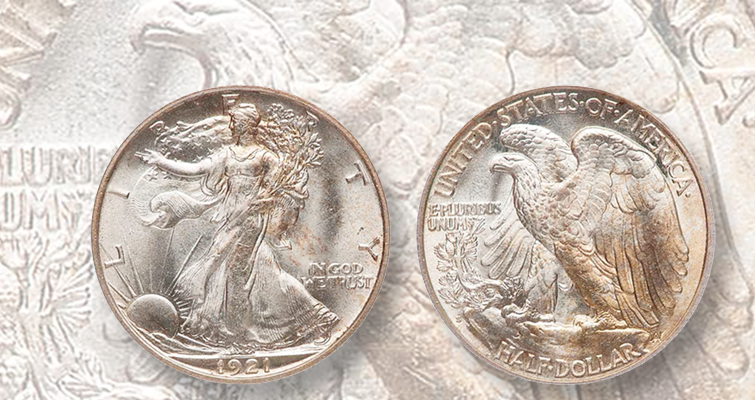
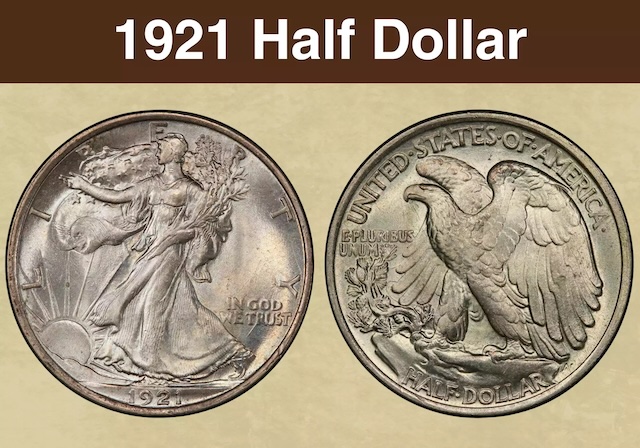
The 1921 Half Dollar Value Guide

One example — a 1921-S graded NGC MS-66 — sold for $188,000 at Heritage Auctions. Even a worn, heavily circulated 1921 half dollar starts around $110. With three key-date mint marks, low mintages under 550,000, and a post-WWI recession story, this is the most sought-after year in the entire Walking Liberty series.

★★★★★ 4.8 / 5 · Rated by 1,347 collectors
Check My 1921 Half Dollar Value →
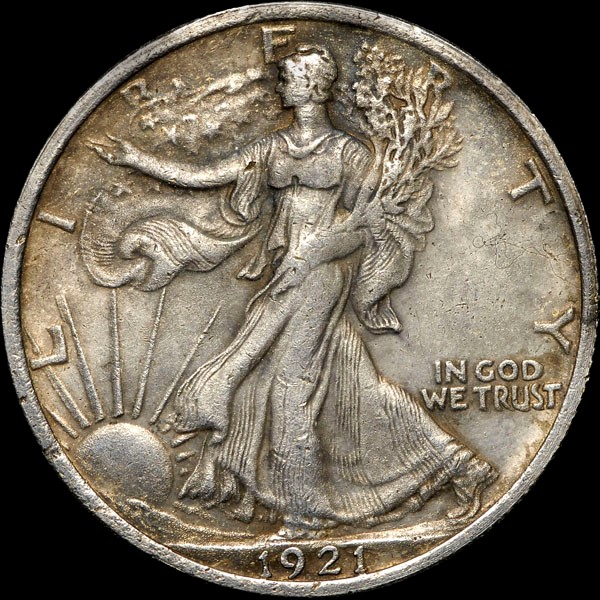
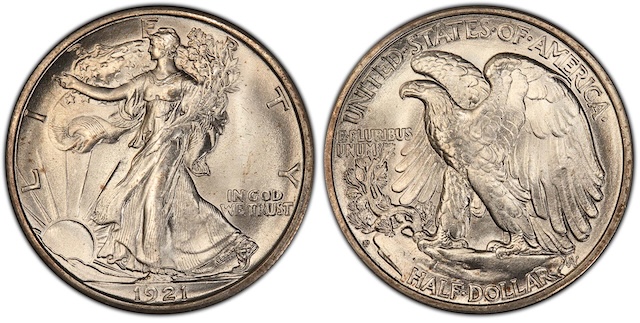
1921 Walking Liberty Half Dollar obverse and reverse, key date coin
$188K
Top auction record (1921-S NGC MS-66, Heritage 2016)
208K
Lowest mintage in the series (1921-D Denver)
90%
Silver content — 0.3617 oz pure silver per coin
3
Key date mint marks — Philadelphia, Denver, San Francisco

Free 1921 Half Dollar Value Calculator

Select your mint mark, condition, and any known errors to instantly estimate your coin's value.

Step 1 — Mint Mark
Step 2 — Condition
Step 3 — Known Errors (optional)

If you're not yet sure about your coin's mint mark or condition, there's a free 1921 Half Dollar Coin Value Checker that lets you upload photos and get an AI-assisted identification before using the calculator above.

1921-D Walking Liberty Half Dollar Self-Checker

The 1921-D is the rarest coin in the entire Walking Liberty series by mintage — only 208,000 were struck. Use this checklist to confirm whether your coin is the genuine key-date Denver issue.

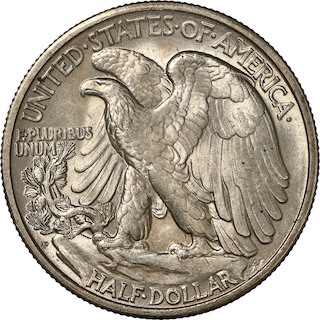
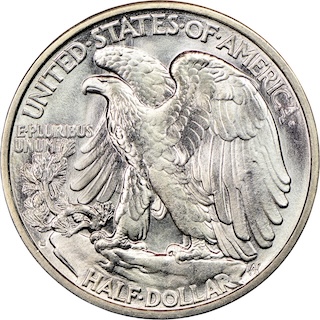
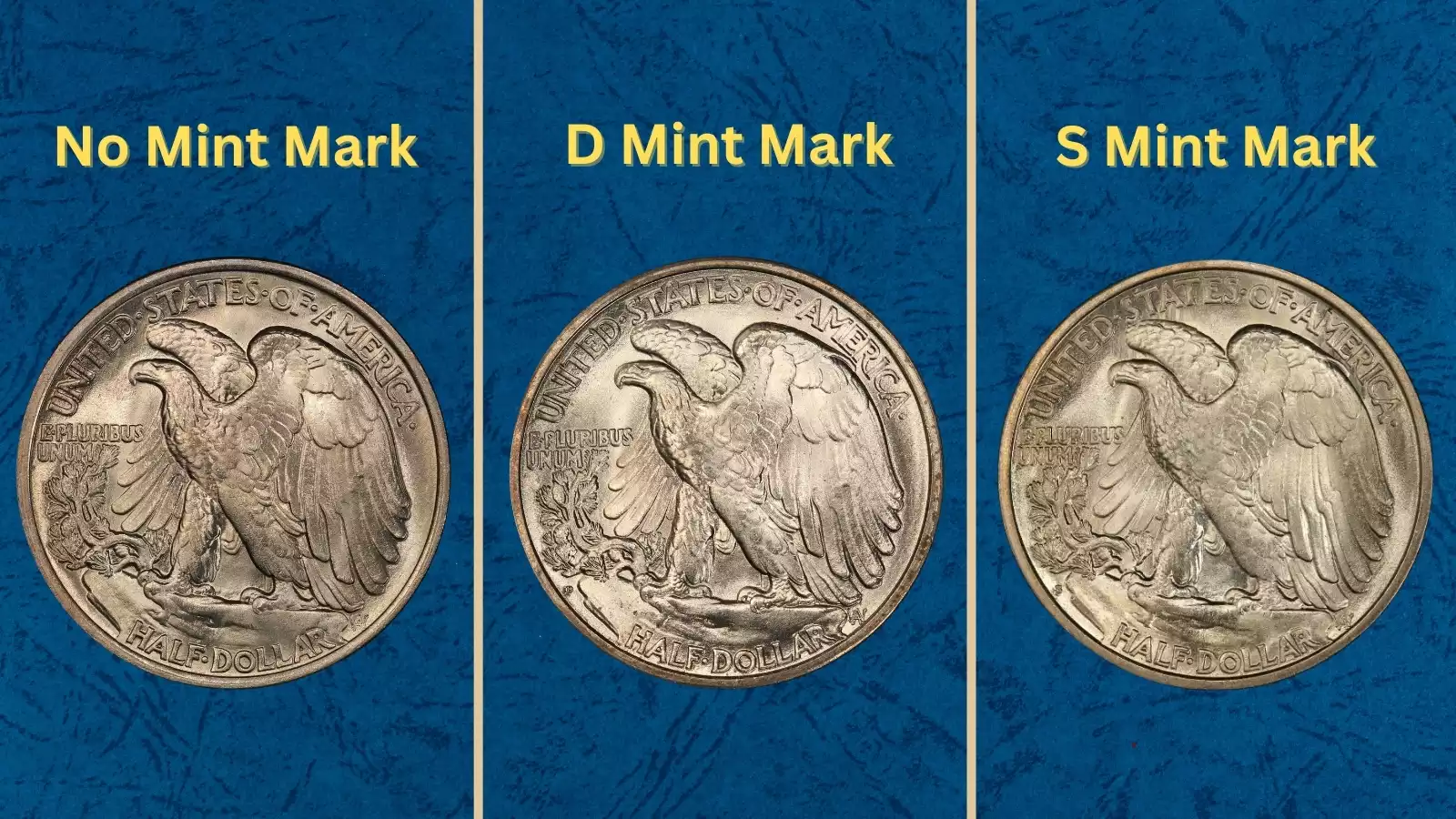
1921-D Walking Liberty half dollar reverse mint mark comparison — genuine D mint mark vs no mint mark

⚠️ Common / Philadelphia Issue

  • No mint mark anywhere on reverse
  • Mintage: 246,000 — still scarce but less so than Denver
  • Generally well-struck; clean surface details
  • Worth $110–$175 in Good grade

🏆 Rare — Genuine 1921-D

  • Small "D" mint mark on reverse lower-left rim, below olive branch
  • Mintage: 208,000 — lowest in the series
  • Strike often crisp with full breast feather detail (unlike 1921-S)
  • Worth $160–$240+ even in heavily worn condition

Want a number, not just a yes/no?

The self-checker tells you what you have — the calculator tells you what it's worth. Enter your mint mark and condition above.

Calculate My Coin's Value

Everything on This Page

Jump directly to any section

The Valuable 1921 Half Dollar Errors (Complete Guide)

The 1921 Walking Liberty half dollar's three varieties are all key dates in their own right — but beyond mint marks, a handful of minting errors and premium strike characteristics can substantially increase value above the standard price guide. Here is everything collectors look for when evaluating a 1921 half.

1921-D Walking Liberty half dollar reverse close-up showing D mint mark

1921-D Denver Mint Key Date

RAREST
$160 – $168,000+

The 1921-D Walking Liberty half dollar carries the lowest mintage of the entire 31-year series — just 208,000 coins produced by the Denver Mint during a postwar recession. This one-year-only Denver Walker (Denver did not produce halves again until 1934) occupies a singular position in American numismatics.

Visually, the "D" mint mark sits on the reverse lower-left rim below the olive branch. Unlike the 1921-S, the Denver issue typically exhibits crisp, full strikes with well-defined breast feathers on the eagle and Liberty's outstretched hand fully resolved — making high-grade survivors particularly appealing.

In circulated grades the 1921-D is the most expensive of the 1921 trio. In gem Mint State it ranks "tied for third rarest" in the entire series according to PCGS CoinFacts, behind only the 1921-S and 1919-D. The PCGS population shows only three examples at MS-66, with none finer.

How to spot it

Use a 10× loupe to find the small "D" on the reverse lower-left rim, directly below the olive branch near the eagle's tail. Compare font style to known genuine examples; altered-date fakes exist.

Mint mark

D (Denver Mint only) — Denver did not strike Walking Liberty halves again until 1934.

Notable

Auction record: $168,000 for PCGS MS-66 at Heritage Auctions, January 3, 2018 (PCGS #6584). PCGS population: only three MS-66 examples certified, none finer. Die state significantly affects premium at this level.

1921-S Walking Liberty half dollar reverse showing S mint mark and eagle detail

1921-S San Francisco Key Date

MOST VALUABLE
$70 – $188,000+

With a mintage of 548,000, the 1921-S produced the most coins of the three 1921 Walker varieties — yet it holds the series' all-time auction record at $188,000 for an NGC MS-66 sold at Heritage Auctions on June 8, 2016. This paradox is explained by survival rates: most 1921-S examples saw heavy circulation during the recession.

Strike quality is the critical diagnostic for the San Francisco issue. Most 1921-S halves show notorious softness on Liberty's head, her right-facing hand, and the central eagle detail — a documented weakness of the San Francisco Mint's hub pressure during this period. A boldly struck example with full Liberty head detail is exceptionally rare.

PCGS notes the 1921-S as the "second rarest" Walker in gem condition, behind only the 1919-D. The value spread between MS-65 and MS-66 is dramatic: an MS-65 example has sold for over $165,000, while MS-66 represents an elite rarity with only a handful known.

How to spot it

Locate the "S" on the reverse lower-left rim. Then examine Liberty's head under a 10× loupe — full, sharp hair detail on the 1921-S commands massive premiums over soft-struck examples of the same date.

Mint mark

S (San Francisco Mint) — on the reverse, lower-left rim below the olive branch.

Notable

Series auction record: $188,000 for NGC MS-66 at Heritage Auctions, June 8, 2016 (confirmed by PCGS auction data). PCGS notes only 17 coins certified MS-65 or better at NGC for this date.

1921 Walking Liberty half dollar doubled die obverse showing doubling on the date 1921

Doubled Die Obverse (DDO)

MOST FAMOUS
$300 – $5,000+

Doubled die obverse errors on 1921 Walking Liberty halves occur when the working die receives multiple impressions from the master hub at slightly different angles or positions during the die-making process. The result is a coin showing a distinct secondary impression — a "ghost" offset from the primary design elements.

On the 1921 DDO, doubling is most prominently visible in the date "1921," the word LIBERTY along the upper rim, and in some instances across the folds of Liberty's gown and her outstretched arm. The doubling should be clearly visible as a distinct, mechanical shift — not simple die fatigue or machine doubling, which lack value premium.

The complex high-relief Weinman design created demanding hubbing conditions throughout the Walking Liberty series, making genuine DDO varieties more prevalent than on simpler low-relief designs. Confirmed examples with strong, clear doubling on the date command meaningful premiums from both error specialists and date collectors alike.

How to spot it

Under a 10× loupe, examine the date digits "1921" and the letters of LIBERTY at the upper rim for a distinct secondary impression offset from the primary. Machine doubling appears flat and shelf-like; true DDO shows rounded secondary digits with depth.

Mint mark

Can appear on P (Philadelphia), D (Denver), or S (San Francisco) issues; DDO affects the obverse die regardless of mint.

Notable

The Walking Liberty series has documented DDO years including 1921 per CONECA listings. Strong examples confirmed by PCGS or NGC as FS-designated varieties command the highest premiums, especially on already-scarce 1921 dates.

1921 Walking Liberty half dollar repunched mint mark showing secondary D or S impression

Repunched Mint Mark (RPM)

BEST KEPT SECRET
$200 – $3,500+

Repunched mint mark errors on 1921 Walking Liberty halves were created by the manual process of punching the mint mark into the working die. If the initial punch was poorly aligned or insufficiently deep, mint workers would strike a second impression — sometimes at a slightly different angle or position — creating a doubled or offset mint mark visible under magnification.

On 1921 Walking Liberty halves, RPM varieties are documented for both the D and S mint marks. The secondary mark may appear as a partial letter impression above, below, or to one side of the dominant mint mark. Some examples show a rotated secondary punch, creating a distinctive tilted doubling that is immediately recognizable to specialists using a 10× loupe.

CONECA and the Cherrypickers' Guide document specific 1921 RPM die marriages. The Walking Liberty series as a whole has 1921 among its known RPM years. Because the underlying 1921-D and 1921-S dates already command significant collector premiums, any confirmed RPM on these key dates multiplies value substantially, particularly in uncirculated condition.

How to spot it

Under a 10× loupe, look at the mint mark on the reverse lower-left rim for a secondary "D" or "S" impression that appears offset, tilted, or partially overlapping the main mark — distinct from a simple weak impression.

Mint mark

D (Denver) and S (San Francisco) issues only — Philadelphia coins carry no mint mark and cannot have RPM errors.

Notable

1921 is listed as a known RPM year for the Walking Liberty series per CONECA records. RPM varieties on the already-scarce 1921-D consistently command substantial premiums above standard price guides, particularly when certified.

Off-center struck 1921 Walking Liberty half dollar showing partial design and blank unstruck area

Off-Center Strike

DRAMATIC ERROR
$400 – $15,000+

An off-center strike occurs when a planchet is not properly centered between the dies at the moment of striking, causing the design to be impressed on only part of the blank, leaving a visible crescent of unstruck silver. On large silver coins like the Walking Liberty half dollar, the collar mechanism must precisely contain and center each planchet — when it fails, the result is dramatic and immediately obvious.

On 1921 off-center halves, the struck area will show a partial Liberty figure, partial eagle, or partial lettering depending on the direction and degree of misalignment. Collectors most prize off-center strikes where the date "1921" remains fully visible within the struck portion — this verifies the coin's key-date status and maximizes numismatic value. Strikes that are between 10% and 50% off-center with a fully readable date are particularly desirable.

Walking Liberty series off-center strikes are documented and tracked by PCGS, which will certify them independently. Given the pre-existing scarcity of any 1921 half dollar, a confirmed off-center strike on a 1921-D or 1921-S represents a truly extraordinary rarity — combining error collector appeal with key-date status in a single coin. Heritage Auctions has recorded dramatic results for off-center Walker halves in the five-figure range.
How to spot it

Look for a coin with a partial design impression and a distinct blank crescent area. Measure the percentage off-center visually — the blank area starts at the edge and the degree determines premium. The date must be in the struck area to confirm the year.

Mint mark

Can occur at any mint (P, D, or S) — off-center strikes are mechanical press errors independent of mint mark application.

Notable

The Walking Liberty series has documented off-center strikes selling at Heritage Auctions for $41,000 in the most dramatic examples. Strikes with the date visible and at 10–50% off-center on a 1921 date would represent extraordinary rarities at the intersection of error and key-date collecting.

1921 Walking Liberty Half Dollar Mintage & Survival Data

Three 1921 Walking Liberty half dollars showing all three mint marks — Philadelphia, Denver, and San Francisco

The year 1921 saw the absolute lowest aggregate Walking Liberty half dollar production of the entire series — a direct consequence of the post-World War I economic recession. All three issues stand as the primary key dates of the series, with the Philadelphia and Denver mintages representing the two lowest individual totals in the series' 31-year history.

Mint Mint Mark 1921 Mintage Series Rank (Lowest) Surviving in MS (Est.)
Philadelphia None 246,000 #2 lowest in series ~40–60 in Gem MS-65+
Denver D 208,000 #1 lowest in entire series ~handful in Gem (MS-66: 3 known at PCGS)
San Francisco S 548,000 ~#6 lowest in series ~17 in MS-65+ at NGC
Total 1921 Production 1,002,000 Lowest-output year in series
Designer: Adolph A. Weinman
Composition: 90% silver, 10% copper
Weight: 12.5 grams
Diameter: 30 mm
Edge: Reeded
Silver content: 0.3617 troy oz
PCGS # (Philadelphia): 6583
Series run: 1916–1947

Found the mintage data compelling?

Now put a dollar figure on it — the calculator combines mint mark, condition, and error variables to give you a precise range for your specific coin.

Get My Coin's Value Estimate

Describe Your Coin for a Detailed Assessment

Describe what you see in plain language — mention the mint mark, any doubling or anomalies, surface condition, and luster. The tool will analyze key terms and return a customized assessment.

Mention these things if you can

  • Mint mark: P (none), D, or S
  • Overall wear level (heavy / moderate / light)
  • Any doubling on the date or LIBERTY
  • Whether the coin has been cleaned
  • Strike quality on Liberty's hand

Also helpful

  • Original luster present or not
  • Toning color and coverage
  • Visible contact marks or scratches
  • Any mint mark anomalies (RPM)
  • Whether you have a weight / scale reading

1921 Walking Liberty Half Dollar Value Chart at a Glance

For a thorough complete 1921 half dollar identification walkthrough with photo comparisons, the linked guide covers strike quality assessment, surface characteristics, and authentication tips in full detail. The chart below represents approximate market ranges based on publicly available auction data and price guides.

Variety Worn (G–AG) Circulated (F–EF) Uncirculated (MS 60–64) Gem MS (MS 65+) Rarity Tier
1921 Philadelphia (no mm) $110–$175 $300–$900 $3,000–$9,000 $12,000+ Rare
⭐ 1921-D Denver (KEY DATE) $160–$240 $400–$1,200 $3,400–$15,000 $55,000–$168,000 Extreme Rarity
🏆 1921-S San Francisco (RECORD HOLDER) $70–$140 $300–$1,000 $3,000–$11,000 $60,000–$188,000 Extreme Rarity
DDO (any mint) $300+ $600–$2,000 $2,000–$5,000 $5,000+ Valuable
RPM (D or S mint) $250+ $500–$1,500 $2,000–$4,000 $4,000+ Valuable
Off-Center Strike (any mint) $400+ $800–$3,000 $3,000–$8,000 $8,000–$15,000+ Rare

★ Row highlighted in gold = 1921-D signature key date. Red row = 1921-S auction record holder. Values are approximate ranges; actual results depend on strike quality, surface preservation, and current market demand. Silver melt value (~$27+ per coin) provides a floor.

📱 CoinKnow lets you snap a photo of your 1921 half dollar and get an instant estimated value and grade on your phone — a coin identifier and value app.

How to Grade Your 1921 Walking Liberty Half Dollar

1921 Walking Liberty half dollar grading strip showing four condition tiers from worn to uncirculated

Worn (G–AG)

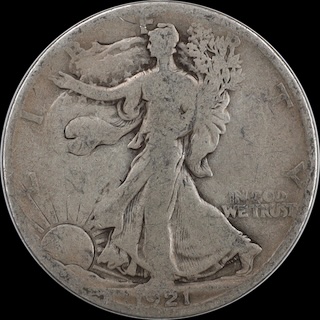
Heavy wear covers the entire surface. Liberty's left arm has merged with the branches at her waist, the hand no longer visible. Sun rays are faded and center ones are shortened. The rim often barely clears the lettering. Still highly desirable and worth well above face value for all 1921 dates.

$70 – $240

Circulated (F–EF)

Moderate to light wear on high points. In Fine, the folds in Liberty's gown remain visible with moderate flatness along the center. In Extremely Fine, detail is sharp everywhere except the very highest design points — Liberty's hand and the eagle's central breast feathers show just slight softness from wear.

$300 – $1,200

Uncirculated (MS 60–64)

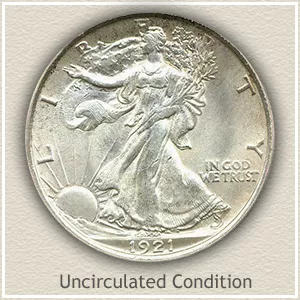
No wear; original mint luster present across surfaces. Liberty's outstretched arm and rear leg retain unbroken cartwheel luster. Examine carefully: the 1921-S frequently shows strike softness that can mimic wear on Liberty's head — this is a strike issue, not wear, and is expected for the date. Philadelphia issue luster is often satiny; Denver can range from soft to frosty.

$3,000 – $15,000

Gem MS (MS 65+)

Full original luster with only minimal contact marks. At MS-65, surfaces are nearly pristine with a few scattered small marks acceptable. MS-66 and above is extraordinarily rare for all 1921 dates — PCGS reports only three 1921-D examples at MS-66, none finer. Strike quality at this level separates the 1921-S (notoriously soft) from the Philadelphia and Denver issues.

$12,000 – $188,000+

💡 Pro Tip: Strike Designation Matters

For the 1921 Walking Liberty series, strike quality is as important as grade. The Philadelphia issue typically shows sharp, full-strike detail. The Denver 1921-D usually strikes well with good breast feather definition. The 1921-S is notoriously weakly struck — a boldly struck example with full detail on Liberty's head and hand is exceptionally rare and can command dramatic premiums far beyond standard price guide values for its assigned grade. Always assess strike separately from wear when evaluating a 1921-S.

🔍 CoinKnow helps you compare your coin's surfaces against certified graded examples to better gauge condition before consulting a dealer — a coin identifier and value app.

Where to Sell Your Valuable 1921 Walking Liberty Half Dollar

All three 1921 Walking Liberty half dollars are key dates that attract serious collector demand at every grade level. Choosing the right sales venue can make a significant difference in final realized price.

Best for High-Grade & Gem Coins

🏛️ Heritage Auctions

Heritage Auctions holds the auction records for both the 1921-S ($188,000, MS-66, 2016) and the 1921-D ($168,000, MS-66, 2018). For any uncirculated or gem-quality 1921 half dollar, major auction houses including Heritage, Stack's Bowers, and GreatCollections deliver the widest pool of serious bidders and the highest realized prices. Expect 17–20% buyer's premium from the buyer's side; seller's fees are negotiable for valuable coins.

Fast & Accessible

💻 eBay

For circulated 1921 halves in the $100–$1,500 range, eBay reaches millions of buyers and generates competitive bidding. Check what 1921 half dollars have sold at on completed eBay listings to benchmark your asking price before listing. Always list with multiple clear photos of both sides and the mint mark area. PCGS or NGC certification dramatically improves buyer confidence and closing price for better examples.

Immediate Cash

🏪 Local Coin Shop

A reputable local dealer (use the PCGS or NGC dealer finder) can provide an immediate cash offer — typically 50–70% of retail value for circulated key dates, slightly better for exceptional pieces they can flip quickly. The convenience of no shipping risk is valuable, especially for uncertified coins. Get at least two independent dealer opinions before selling, as 1921 half dollar knowledge varies significantly between shops.

Community Pricing

💬 Reddit r/Coins4Sale

The r/Coins4Sale and r/CoinSales communities offer direct collector-to-collector sales with no seller fees. Serious Walking Liberty collectors browse these communities regularly. Post high-resolution photos of both sides and the mint mark, provide an honest grade assessment, and price using PCGS price guide as reference. Best for mid-grade circulated examples where Heritage would charge disproportionate seller fees.

🎓 Get It Graded First
For any 1921 half dollar appearing to grade EF or better, professional certification from PCGS or NGC is strongly recommended before selling. Certified coins consistently achieve 20–40% higher prices than raw (unslabbed) examples of the same quality. The $100–$150 grading cost is easily justified for coins worth several hundred dollars or more — and essential for the high-value uncirculated examples where grade nuances translate to thousands of dollars in value difference.

1921 Half Dollar FAQ

How much is a 1921 Walking Liberty half dollar worth?
A heavily worn 1921 Philadelphia half dollar in Good condition starts around $110–$175. In Extremely Fine it climbs to several hundred dollars. Uncirculated examples range from roughly $3,000 to over $12,000 in Gem MS-65. The 1921-D is the scarcest of the three and commands the highest prices in circulated grades. Always check your coin's mint mark before estimating value.
What is the rarest 1921 half dollar?
The 1921-D (Denver Mint) has the lowest mintage of the entire Walking Liberty series at just 208,000 coins. In circulated grades it is the most expensive of the 1921 trio. In gem Mint State, the 1921-S is considered rarer and holds the overall auction record of $188,000 for an NGC MS-66 sold at Heritage Auctions in June 2016. Both are essential key dates for serious collectors.
What is the auction record for a 1921 half dollar?
The all-time auction record for the 1921 Walking Liberty series belongs to a 1921-S graded NGC MS-66, which realized $188,000 at Heritage Auctions on June 8, 2016. The 1921-D follows with a PCGS MS-66 example that fetched $168,000 at Heritage Auctions in January 2018. Even the Philadelphia issue has sold for over $60,000 in pristine Gem condition.
Where is the mint mark on a 1921 Walking Liberty half dollar?
On 1921 Walking Liberty half dollars, the mint mark — either a 'D' for Denver or 'S' for San Francisco — appears on the reverse side near the lower-left rim, just below the olive branch held by the eagle. Philadelphia coins carry no mint mark at all. The mint mark is small but clearly visible with a loupe or even careful naked-eye inspection.
Are 1921 half dollars made of silver?
Yes. All 1921 Walking Liberty half dollars are composed of 90% silver and 10% copper. Each coin weighs 12.5 grams and contains 0.3617 troy ounces of pure silver. At current silver prices the melt value provides a meaningful floor, but for all three 1921 dates, numismatic collector value far exceeds silver content even in heavily worn condition.
How do I tell a genuine 1921 half dollar from a counterfeit?
Genuine 1921 Walking Liberty half dollars weigh exactly 12.5 grams and measure 30 mm in diameter with reeded edges. Check for sharp, correct lettering styles and crisp design details consistent with authentic Weinman dies. Known counterfeits of this key date exist — NGC has confirmed altered-date fakes. Professional certification by PCGS or NGC is strongly recommended for any high-value example.
What makes the 1921 Walking Liberty half dollar a key date?
A post-World War I economic recession dramatically cut Mint production in 1921. Philadelphia struck only 246,000 halves, Denver just 208,000 — the lowest mintage in the entire Walking Liberty series — and San Francisco produced 548,000. Unlike earlier scarce issues, these coins were not widely saved by collectors, so high-grade survivors are genuinely rare today.
What errors exist on 1921 Walking Liberty half dollars?
Known error varieties include doubled die obverse (DDO) with doubling visible on Liberty's figure or the date, repunched mint mark (RPM) on the Denver and San Francisco issues, and mechanical errors such as off-center strikes and double strikes. The complex high-relief Weinman design created challenging striking conditions that contributed to these varieties. Any confirmed error dramatically increases collector value above standard prices.
Should I clean my 1921 half dollar?
Never clean a 1921 Walking Liberty half dollar under any circumstances. Cleaning destroys original mint luster and surface patina, which can reduce a coin's value by 50% or more in collector markets. Numismatists strongly prefer original, uncleaned surfaces even when toned dark or appearing dirty. If you're uncertain about your coin's condition, have it evaluated by a professional before doing anything.
Is the 1921-S half dollar worth more than the 1921-D?
It depends on grade. In lower circulated grades (Good through Fine), the 1921-D commands higher prices due to its lower mintage of 208,000 versus 548,000 for the 1921-S. However, in grades VF and higher the 1921-S becomes more expensive, and in Gem Mint State the 1921-S is the rarer and pricier coin — holding the $188,000 series auction record compared to $168,000 for the 1921-D.

Ready to find out what your coin's worth?

Use our free calculator — select your mint mark, condition, and any errors. Results in seconds, no signup required.

Check My 1921 Half Dollar Value →